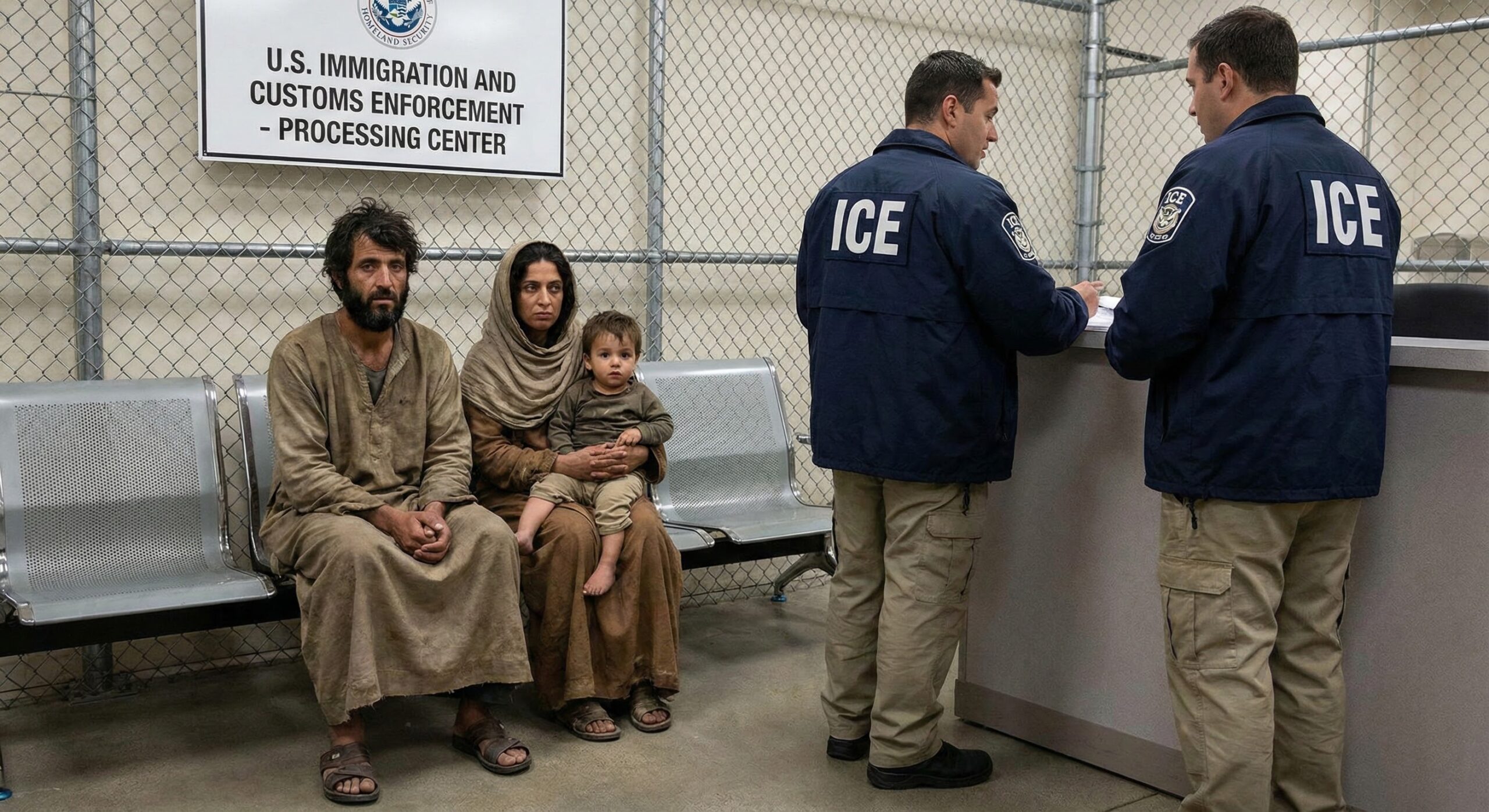
This Christmas I’ve kept thinking about how Mary and Joseph had to flee Judea. They found refuge in Egypt in order to protect the young Jesus from autocratic government persecution:
An angel of the Lord appeared to Joseph in a dream and said, “Rise, take the child and his mother, and flee to Egypt, and remain there until I tell you, for Herod is about to search for the child, to destroy him.” And he rose and took the child and his mother by night and departed to Egypt and remained there until the death of Herod.
Matthew 2:13b-15a (ESV)
What if Jesus had been born today instead? Would his family have found refuge in America? (I’m no immigration lawyer, so I’ve relied on Gemini to help navigate the complicated system.) Given their dire and urgent situation, they wouldn’t have been able to apply for an immigrant visa through the Green Card Lottery, which is a years-long process. They also wouldn’t have been able to enter under a refugee program, since that also involves a long process with an extensive vetting pipeline before they would have been possibly admitted as refugees. They also wouldn’t have been able to use Humanitarian Parole, since that is also a slow process. So for legal entry, a tourist visa seems like the only viable pathway.
If they were modern Israeli citizens, there is the Electronic System for Travel Authorization (ESTA) which allows for approval within 72 hours.
On the other hand, if they were Palestinians (as Bethlehem is in Palestine), there is no such 72-hour approval for flight. They’d have to get a visa interview. But, because of Presidential Proclamation 10998 (Restricting and Limiting the Entry of Foreign Nationals) which takes effect on January 1st, 2026:
the United States is suspending or limiting entry and visa issuance to nationals of 39 countries as well as individuals applying using travel documents issued or endorsed by the Palestinian Authority.
So in this case of being Palestinian Authority passport holders, they’d effectively be banned.
Let’s say they were fortunate to have the freedom of travel as Israeli citizens; this still wouldn’t necessarily help them. If they came as tourists due to the urgency, but then claimed asylum upon entering, they would be arrested and detained. One of the few groups currently being admitted into the USA as refugees is the white Afrikaners from South Africa. Recently, one such Afrikaner flew to the US and then requested asylum. Since he didn’t go through the refugee program, he was put into handcuffs and sent to a federal detention facility where he has been for months now.
So the only viable option I see for Mary and Joseph is to fly to the US and enter with an ESTA tourist visa under false pretenses. Since their stay in America under a tourist visa would be for an indeterminate length, this is technically visa fraud. Even if they intend to return to Judea once the threat has passed, they wouldn’t have known how long that would be. Under ESTA, there is a strict 90-day limit on the length of time that the visitor can remain in the USA. We don’t know how long Herod the Great lived specifically after they escaped, but it was probably at least 90 days or maybe even up to a couple of years. If they fled to America under ESTA, they would have overstayed their tourist visa. They would have become undocumented immigrants. They would be illegal aliens. (Jesus would be a Dreamer.)
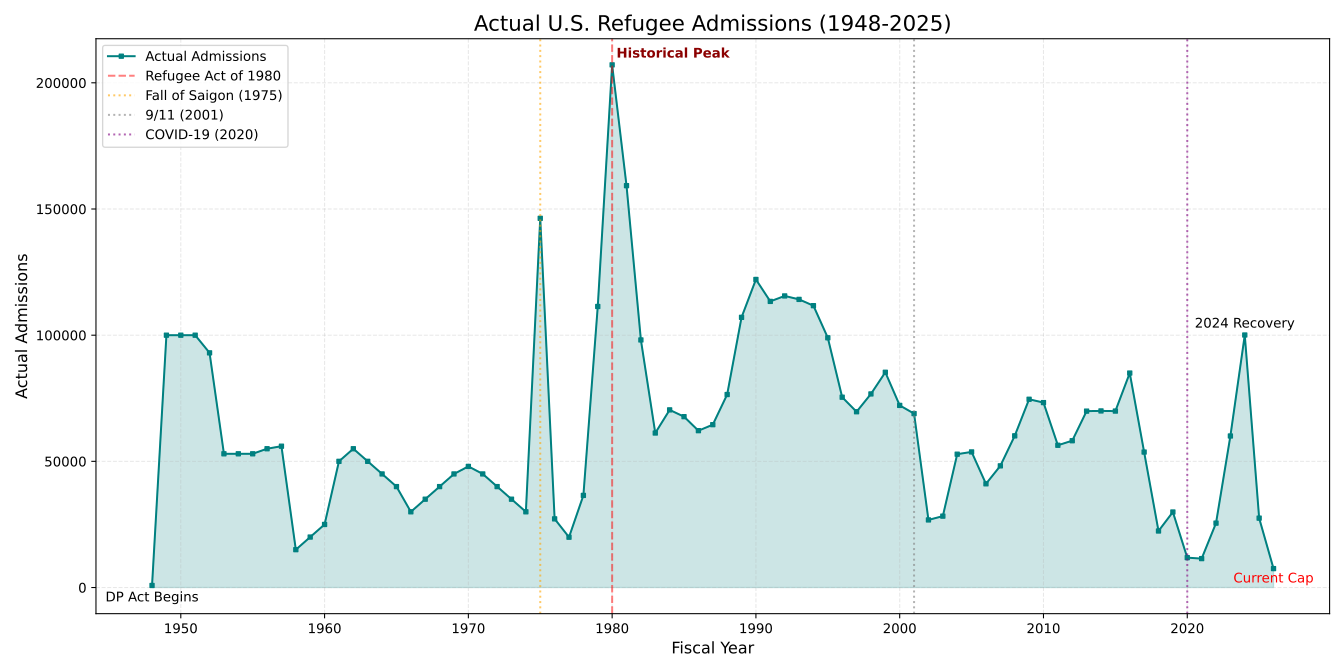
The current administration is aggressively pursuing the deportation of undocumented immigrants, but it is also cutting the legal pathways for immigrants (e.g. Temporary Protected Status), making them also at risk for deportation. When the Refugee Act of 1980 was passed, there was an initial baseline of 50,000 refugees allowed into the country per year (with the actual number admitted being much higher). Under the current administration, the yearly cap has been reduced to an all-time low of 7,500 refugees. Furthermore, by executive order, most of these are to “primarily be allocated among Afrikaners from South Africa” (as also noted above). So even if Mary and Joseph had fled to a third country and applied with the U.S. Refugee Admissions Program, they would have no feasible chance of being accepted since they are not Afrikaners. These Jews would not be accepted as refugees.
What is particularly striking to me about the dismantling of the refugee program is that it exists today in part because of a modern persecution of Jews by Nazi Germany. In 1939, a German ocean liner named the MS St. Louis sailed to the Americas with nearly a thousand Jewish refugees on board. It attempted to dock in America but was denied (after first being denied in Cuba and later denied by Canada). The ship was forced to return to Europe where tragically over a quarter of the passengers were killed in the Holocaust. After the war, moral outrage over the Holocaust led to the US passing the Displaced Persons Act of 1948 (with its key amendment in 1950) to allow refugees to enter the country. Three decades later, the more comprehensive Refugee Act of 1980 was passed:
The Act created a uniform and comprehensive policy to proactively address refugee admissions by:
- Removing the geographic and ideological limits on the definition of “refugee” that had been introduced by the 1965 Amendments to the INA. The new law formally adopted the United Nations’ definition.
- Providing the first statutory basis for asylum.
- Increasing the number of refugees who could be admitted annually.
- Creating the Office of Refugee Resettlement to oversee resettlement programs.
Under the Act, the president, in consultation with Congress, sets the annual number of refugee admissions and the allocation of these admissions to refugees coming from various parts of [the] world.
According to former Deputy Secretary of State William J. Burns, tragedies like that of the MS St. Louis prompted the international community to take action to protect refugees. Additionally:
A photo of the M.S. Saint Louis hangs in the front office of the State Department’s refugee bureau as a powerful reminder and source of motivation. Our actions since the Saint Louis, we hope, speak more eloquently than any words could to our dedication and commitment to shelter and to protect.
However, it seems our dedication and commitment in the United States is dwindling. I asked Gemini to create a graph of the actual number of refugees admitted per year since 1948:
Source code
import pandas as pd
import matplotlib.pyplot as plt

# Data Construction based on search results and historical summaries
data = {
    # Early Acts and Ad-hoc (estimates and rounded historical totals)
    1948: 813, 1949: 100000, 1950: 100000, 1951: 100000, 1952: 93000,
    1953: 53000, 1954: 53000, 1955: 53000, 1956: 55000, # Hungarian Revolution surge
    1957: 56000, 1958: 15000, 1959: 20000, 1960: 25000, # Start of Cuban wave
    1961: 50000, 1962: 55000, 1963: 50000, 1964: 45000, 1965: 40000, # Freedom Flights / Cuban program
    1966: 30000, 1967: 35000, 1968: 40000, 1969: 45000, 1970: 48000,
    1971: 45000, 1972: 40000, 1973: 35000, 1974: 30000,
    # Standardized Reporting era starts with 1975 data from RPC
    1975: 146304, 1976: 27206, 1977: 19946, 1978: 36507, 1979: 111363,
    # Official DHS Yearbook Table 13 (Refugee Act of 1980 era)
    1980: 207120, 1981: 159250, 1982: 98100, 1983: 61220, 1984: 70390, 1985: 67700,
    1986: 62150, 1987: 64530, 1988: 76480, 1989: 107070, 1990: 122070, 1991: 113390,
    1992: 115550, 1993: 114180, 1994: 111680, 1995: 98970, 1996: 75420, 1997: 69650,
    1998: 76710, 1999: 85290, 2000: 72170, 2001: 68920, 2002: 26790, 2003: 28290,
    2004: 52840, 2005: 53740, 2006: 41090, 2007: 48220, 2008: 60110, 2009: 74600,
    2010: 73290, 2011: 56380, 2012: 58180, 2013: 69910, 2014: 69980, 2015: 69920,
    2016: 84990, 2017: 53690, 2018: 22410, 2019: 29920, 2020: 11840, 2021: 11450,
    2022: 25520, 2023: 60050, 2024: 100060,
    # 2025 estimate based on Q1 data and suspension in Jan 2025
    2025: 27500,
    # The current refugee cap (allocated primarily to Afrikaners).
    2026: 7500
}

df = pd.DataFrame(list(data.items()), columns=['Year', 'Admissions'])
df.to_csv('actual_refugee_admissions_1948_2025.csv', index=False)

# Plotting
plt.figure(figsize=(14, 7))
plt.plot(df['Year'], df['Admissions'], marker='s', linestyle='-', color='teal', markersize=3, label='Actual Admissions')
plt.fill_between(df['Year'], df['Admissions'], color='teal', alpha=0.2)

# Specific Event Vertical Lines
plt.axvline(x=1980, color='red', linestyle='--', alpha=0.5, label='Refugee Act of 1980')
plt.axvline(x=1975, color='orange', linestyle=':', alpha=0.6, label='Fall of Saigon (1975)')
plt.axvline(x=2001, color='gray', linestyle=':', alpha=0.6, label='9/11 (2001)')
plt.axvline(x=2020, color='purple', linestyle=':', alpha=0.6, label='COVID-19 (2020)')

# Text Annotations
plt.text(1948, -5500, 'DP Act Begins', horizontalalignment='center')
plt.text(1980.3, 210000, 'Historical Peak', horizontalalignment='left', color='darkred', fontweight='bold')
plt.text(2024, 103000, '2024 Recovery', horizontalalignment='center')
plt.text(2026, 2000, 'Current Cap', horizontalalignment='center', color='red')

plt.title('Actual U.S. Refugee Admissions (1948-2025)', fontsize=16)
plt.xlabel('Fiscal Year', fontsize=12)
plt.ylabel('Actual Admissions', fontsize=12)
plt.grid(True, linestyle='--', alpha=0.3)
plt.legend()

plt.tight_layout()
plt.savefig('actual-us-refugee-admissions-graph.png')
plt.savefig('actual-us-refugee-admissions-graph.svg', format='svg')
print(df.tail(15))Code language: Python (python)
This next year, 2026, is poised to have the lowest number of refugees welcomed into the United States since World War II.
When reflecting on the possibility that Jesus was at one time a refugee or an asylum seeker, I can sense personal experience when he depicts a coming reckoning:
Jesus: “I was a stranger and you did not invite me in, I needed clothes and you did not clothe me, I was sick and in prison and you did not look after me.”
The condemned: “Lord, when did we see you hungry or thirsty or a stranger or needing clothes or sick or in prison, and did not help you?”
Jesus: “Truly I tell you, whatever you did not do for one of the least of these, you did not do for me.”
Matthew 25:43-45 (ESV), with my reformatting
Instead of taking in the stranger and looking after those in prison, the United States has been seeking out the stranger (foreigner) to put into detention or even prison, as in the case of CECOT. Even immigrants who had come here legally have had their legal status revoked so they can be detained and deported: 1.6 million people lost legal right to stay in the U.S. in 2025.
The Hebrew Bible (aka the Old Testament) has many admonitions for the Israelites to care for foreigners, for example:
When a foreigner resides among you in your land, do not mistreat them. The foreigner residing among you must be treated as your native-born. Love them as yourself, for you were foreigners in Egypt.
Leviticus 19:33-34a (NIV)
This sounds an awful lot like due process; it also sounds like an admonition to treat foreigners with dignity as human beings, not to denigrate them as animals. The scriptural commands for how to treat foreigners justly because they were foreigners in Egypt also circle back to Jesus. An Old Testament prophecy from Hosea 11:1 is attributed to him in Matthew 2:15: “Out of Egypt I called my son.” I find it interesting to think about the prior scriptural commands to care for the foreigner when thinking about Jesus’s future experience as a refugee in Egypt; it makes me think about God perhaps establishing a regional norm so that his Son would be protected when he was a refugee. Jesus also identifies with the foreigner and he takes it personally the way they are treated (or mistreated).
When thinking about undocumented immigrants who live in our communities, I also think about whom Jesus identifies as our neighbors, those we are to love as ourselves. They’re not just fellow citizens (neighbors) of our own country, people who are just like us. In Luke 10:25-37, he tells a story of how a man was robbed and left for dead. The man’s fellow countrymen passed him by and didn’t offer any help. But when a foreigner (even a despised Samaritan) came by, the foreigner had compassion on the beaten man and cared for him. Jesus said we are to be a good neighbor like that foreigner.
In the current struggle against antisemitism, I find it inconsistent that refugee laws passed in part to rectify how the United States failed to protect Jewish refugees during the Holocaust are now being suppressed, even as many espouse America as being a “Christian nation”. And this Christmas season, this is brought all the more into focus when thinking about how Jesus was once a refugee and that he likely would not have found refuge in America today.
Leave a Reply